

Die TBBF freut sich drei neue Junior Trainer begrüßen zu können. Ihre Ausbildung haben Martina Schadewald, Nico Richter und Evelyn Werner bei Edeltraut und Wolfgang Richter erhalten. Seit September verstärken sie nun als Junior Trainer das Angebot an zertifizierten TBBF Trainern und praktizieren unseren Sport zusammen mit Edeltraut und Wolfgang im Verein der Lebensenergie e.V. Suhl.
Tag Archives: Art-Choreo

29
Jul
Jul
Vielleicht erinnerst Du Dich an unsere Ankündigung für die diesjährigen TBBF-Workshops in April und Mai. Sie umfassten alle Disziplinen, einschließlich Art. Wenn Du noch nie an einem Art-Workshop teilgenommen hast, fragst Du Dich vielleicht: „wie sieht das Programm aus / lerne ich, wie man mit Racket und Ball tanzt / muss ich ein Tänzer, ein Akrobat oder beides sein / lerne ich eine Choreographie / wie baue ich meine Fähigkeiten auf und aus / …?
Nun, in gewisser Weise kann man alle obigen Fragen mit „ja“ beantworten – aber auch mit „es kommt darauf an“. Etwas vage? Schau Dir doch einmal die folgenden Workshop-Impressionen an. Ich bin sicher, dass Du Dir diese Fragen am Ende selbst beantworten kannst..

17
Apr
Apr
Roliball France Federation (FRF) organisiert BailongBall Camp
Wann: 12. August – 18. August 2023
Wo: 43150 Les Estables, Frankreich

08
Apr
Apr
Roliball France Federation (FRF) organisiert BailongBall Camp
Wann: 12. August – 18. August 2023
Wo: 43150 Les Estables, Frankreich
[:de]Nach der Pandemiepause veranstaltet die TBBF diesen Frühling wieder eine Live-Veranstaltung – die alljährliche Supervision in Kombination mit zwei Workshops. Vom 27.4. bis zum 2.5. können Teilnehmer alle Disziplinen des BailongBalls trainieren. Alle 3 Veranstaltungen finden in Bensheim statt.
[:
[:
20
Dec
Dec
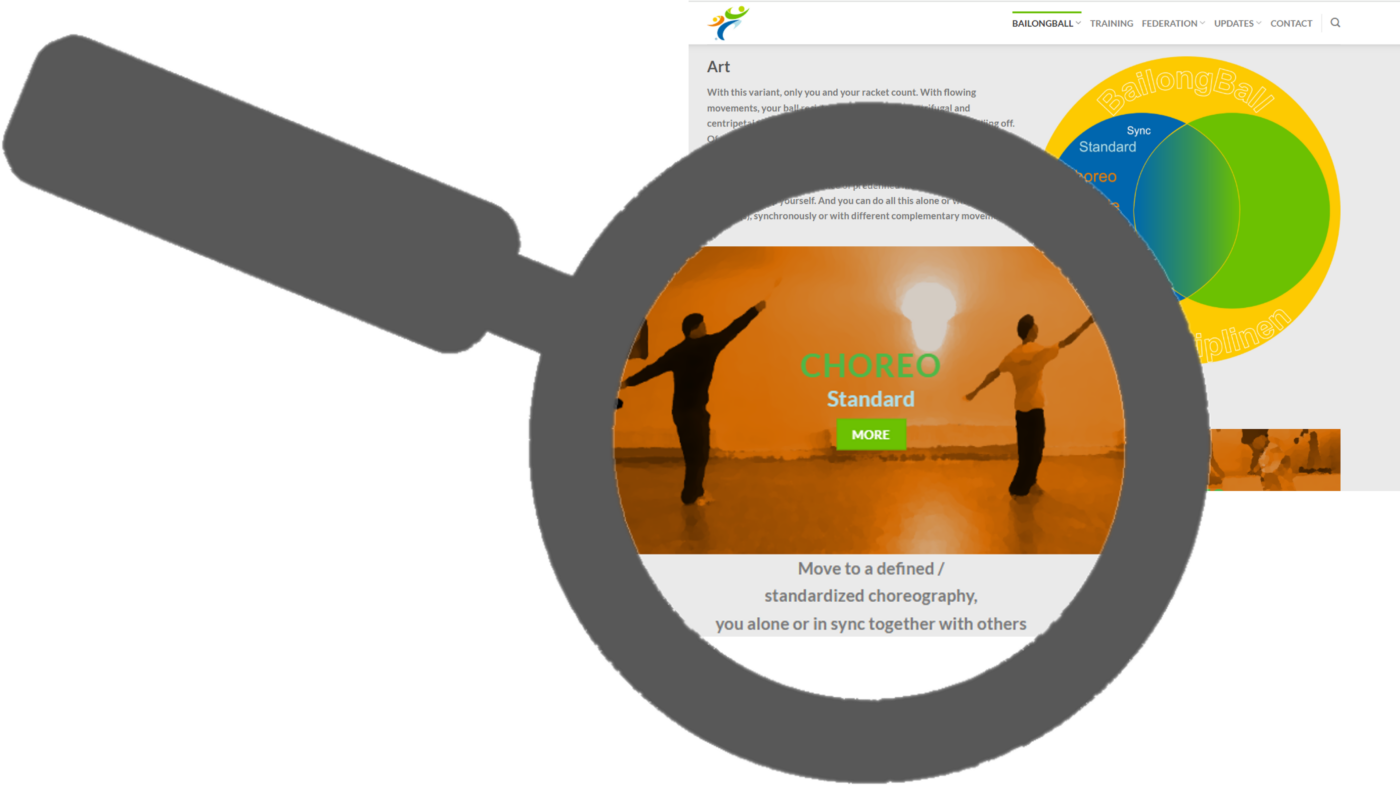
As announced, we are currently expanding our website. This time we are dedicating ourselves to Standard Choreo, as part of the "Art" disciplines of BailongBall. On a new page you will find interesting facts about this discipline and corresponding details about the "Standard" and "Duans" forms.

30
Sep
Sep
In this series of blogs, we introduce you to BailongBall Forms. After having launched respective series on the disciplines of Multiplay and Freestyle, this series covering the discipline Forms, aims to complete your picture of our sport. The series breaks down a particular BailongBall Form into several parts. In each part, we show you round about two elements. At the end of the last part, you will have covered the Form and you will pick up tips and tricks while progressing from one part to the next.

29
Apr
Apr
We started with the following plan: Half the time we train via web conference and the other half traditionally, on site.
So on October 26, 2020, we started our first web conference based training session and shimmied from one pandemic social distancing ruling to the next. Bottom line: the entire Junior Trainer training took place via Zoom.
This required a lot of flexibility from the trainers Susanne Ritz, Mike Ritz and Shannon Ritz as well as from us, but this also had advantages, as we were able to schedule appointments at relatively short notice. We had different time windows, ranging from one hour to 4 hours, including breaks.

25
Apr
Apr
Start October last year – the goal: to become a certified BailongBall Junior Trainer. The plan was a mix of online training and on-site training weekends. The idea was to have regular online sessions that would simplify training schedules for both trainers and trainees and eliminate the need for repeated long trips to the training site. However, the pandemic had its own plans and the training weekends were repeatedly postponed and eventually cancelled altogether. The training was done completely online, as was the exam.

28
Feb
Feb
Freestyle is versatile and embodies the dancing of BailongBall. Flowing, circular, swinging, dynamic movements, full of rhythm. Movements that flow through the whole body – spreading all the way to the fingers. There, the racket continues the movements of the body, often in the form of circles.
In our series “Freestyle Elements”, you got a little insight into what is possible when the racket “is spun”. In parts 1, 2 and 3 you could see how Irina combines variations of racket spinning, with different body movements and sequences.
Maybe you wonder how the racket can spin so elegantly, so smoothly and yet quickly, and still not lose contact with the ball? How do you practice something like that? For example, how does Irina manage to “wrap” the racquet around the ball so elegantly (the so-called “scroll”) as in the video of the third part of the “Freestyle Elements” series?
In our small two-part series on “Finger Skills for Freestyle”, we would like to show you a few exercises that help developing the necessary finger skills. In this first part we will practice with the small racquet, the Bailo. In the second part we will switch to the larger racquet.